The complete guide to trade insurance and liability.
 By Tom Ellis
In the construction and trade sector, one split-second mistake can result in a claim worth hundreds of thousands of pounds. Whether a burst pipe destroys a client's £50,000 kitchen, or a labourer severely injures themselves on your site, operating without the correct insurance is financial suicide.
Many tradespeople buy the cheapest generic policy they can find, only to discover their tools aren't covered overnight, or their Public Liability doesn't meet commercial contract requirements. This guide breaks down exactly what every policy means, the legal minimums you must hold, and how to bulletproof your business against disaster.
Public Liability
The baseline protection against claims of property damage or injury caused to a member of the public.
Employer's Liability
Required by UK law if you employ any staff, including apprentices and labour-only subcontractors.
Tools & Machinery
Covering your van's contents, hired-in diggers, and materials left on site overnight.
Public Liability Insurance (PLI)
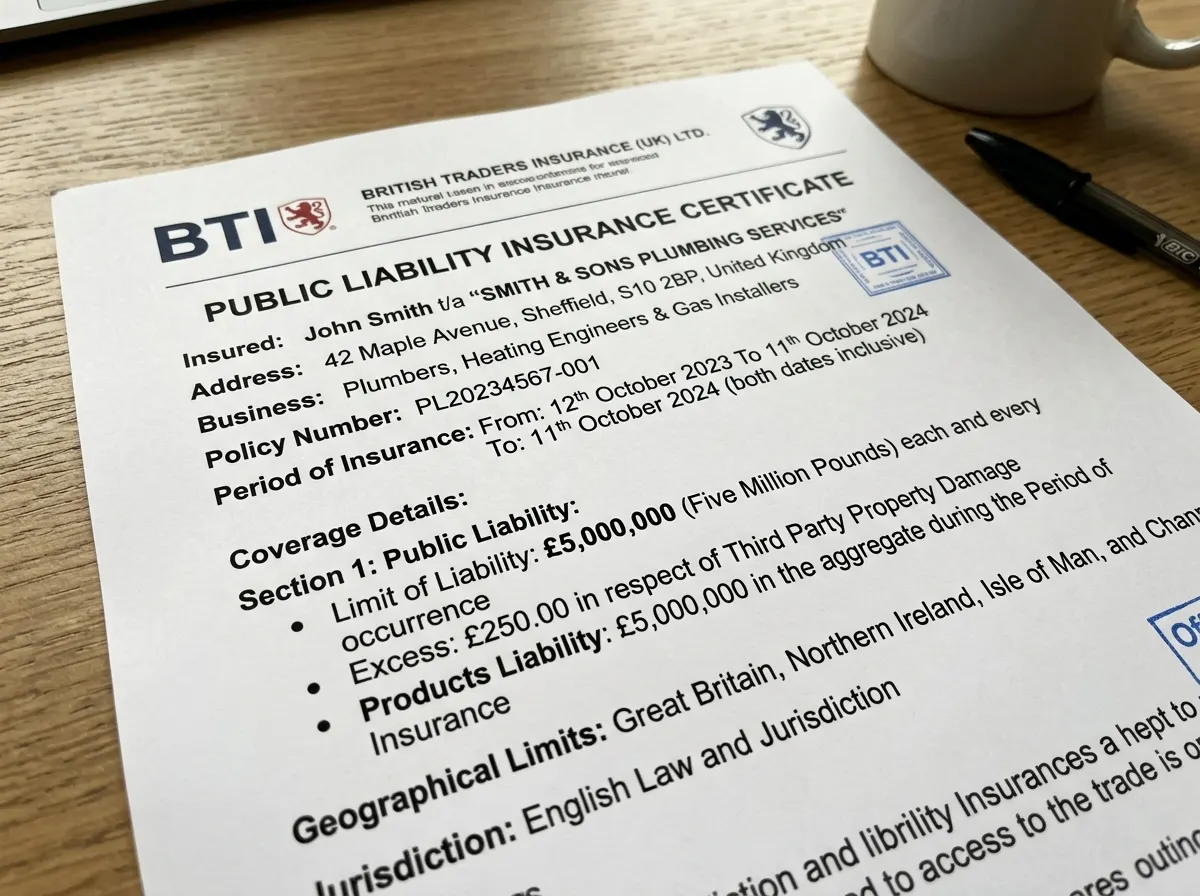
Public Liability Insurance covers your business if a client or member of the public suffers a personal injury, or their property is damaged, because of your business activities. It pays out for the legal compensation, medical costs, and repair bills.
Crucial Distinction
PLI covers consequential damage, not poor workmanship. If you plumb a radiator incorrectly and it leaks, destroying a £10k hardwood floor, PLI pays for the floor. It does not pay you for the time and materials required to fix your dodgy plumbing joint.
Required Levels of Cover
-
£1mMinStandard Domestic Work The bare minimum for sole traders working in private residential properties. £2 million is highly recommended.
-
£5mComCommercial Contracts & Main Contractors If you want to subcontract for a large regional builder or manage commercial premises, they will strictly demand a minimum £5m PLI certificate before you enter the site.
-
£10mGovLocal Authority & Council Work Bidding for school repairs, council housing maintenance, or high-street highway work? £10 million is the non-negotiable entry requirement.
Employer’s Liability Insurance (ELI)
Under the Employers' Liability (Compulsory Insurance) Act 1969, if you employ staff, you are legally obligated to hold ELI. If you are caught operating without it, the Health and Safety Executive (HSE) will fine you £2,500 for every single day you were uninsured.
This insurance covers compensation costs if an employee becomes injured or ill as a direct result of the work they do for you (e.g., falling off your scaffolding, or developing asthma from wood dust). The legal minimum cover is £5 million, but almost all policies provide £10 million as standard.
The "Labour-Only Subcontractor" Trap
Many tradespeople believe they don't need ELI because they only use "self-employed subbies". This is a dangerous misconception. If you hire a Labour-Only Subcontractor (someone who works under your direction, uses your materials, and cannot send a substitute), the law classifies them as an employee for insurance purposes. You MUST have Employer's Liability to cover them.
Who needs ELI?
- ✓ Full-time PAYE staff
- ✓ Part-time workers
- ✓ Apprentices
- ✓ Labour-only subcontractors
- ✓ Temporary casual labourers
- ✗ Bona Fide Subcontractors (They must hold their own insurance)
Tools, Plant & Contract Works Cover
Your van is a target, and a building site is highly vulnerable. Protecting your physical assets and the ongoing project itself is essential to preventing catastrophic cash-flow crises.
Tools in Transit (Van Cover)
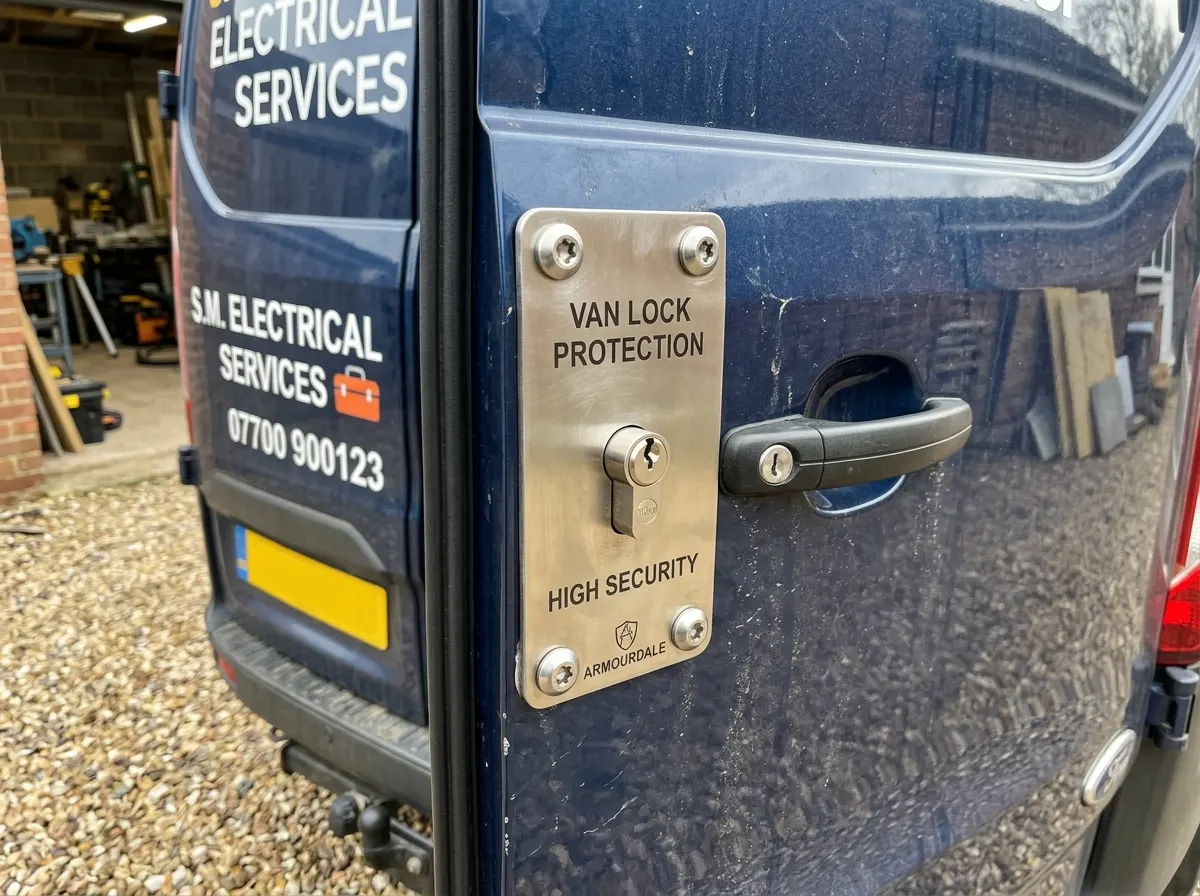
Replaces your hand tools and power tools if they are stolen from your vehicle or destroyed in a crash. However, you must meticulously check the overnight conditions clause. Most insurers will refuse a claim if tools are left in a van overnight unless the vehicle is parked on a private driveway, in a locked garage, or the van has upgraded Thatcham-approved deadlocks and an alarm system.
Hired-in Plant Insurance
If you hire a £30,000 micro-digger or a scissor lift from a hire shop (like Travis Perkins or HSS), you are legally responsible for it while it is in your possession. If it gets stolen from the site overnight, you have to buy the hire company a new one. Hired-in Plant insurance covers this exact scenario and is usually a mandatory requirement before a hire yard will open an account for you.
Contract Works (Contractors All Risks)
Public Liability covers damage to other things. Contract Works covers damage to the actual job you are building. If you are building a £100,000 extension, and a severe storm causes the half-built structure to collapse, or thieves strip the site of £10,000 worth of copper and timber before it's installed, Contract Works pays for the materials and labour required to rebuild it back to the state it was in before the incident.
Stop paying for dead leads.
Join the Pricing Penguin network. We provide UK tradespeople with high-intent, pre-qualified customers who already understand the true cost of quality craftsmanship.
The 14-Day Cooling-Off Period
Under the Consumer Contracts Regulations 2013 [1], if you agree to a quote or sign a contract while physically at a domestic customer's house, it is classed as an "Off-Premises Contract".
By law, domestic customers have a strict 14-day right to cancel this contract for any reason [1]. As a business, you are legally obligated to provide them with written notice of this right and a standard cancellation form before work begins [1].
The "Free Driveway" Loophole
If you fail to give the customer written notice of their 14-day cancellation right, the cooling-off period automatically extends by 12 months [1].
This means a customer could let you build a £15,000 driveway, wait until it is finished, execute their legal right to cancel, and legally owe you nothing. Failing to provide this notice is also a criminal offence prosecutable by Trading Standards [1].
Can I start work immediately?
Yes, but if the customer wants you to start work before the 14 days are up, they must give you an express written request to do so [1]. If they then cancel mid-job, they must pay a proportionate amount for the work you have already completed [1].
The Emergency Exemption
If a customer calls you out for an urgent repair (e.g., a burst pipe flooding their kitchen), the 14-day cancellation right does not apply to the emergency fix [1]. However, it does apply to any extra work you upsell them while there (e.g., fitting a whole new bathroom) [1].
Bespoke Materials
The cooling-off period does not apply to bespoke, made-to-measure goods [1]. If you have ordered custom-sized bi-fold doors or cut custom granite worktops, the customer cannot cancel and demand a refund once production has started [1].
The 14-Day Cooling-Off Period
Under the Consumer Contracts Regulations 2013 [1], if you agree to a quote or sign a contract while physically at a domestic customer's house, it is classed as an "Off-Premises Contract".
By law, domestic customers have a strict 14-day right to cancel this contract for any reason [1]. As a business, you are legally obligated to provide them with written notice of this right and a standard cancellation form before work begins [1].
The "Free Driveway" Loophole
If you fail to give the customer written notice of their 14-day cancellation right, the cooling-off period automatically extends by 12 months [1].
This means a customer could let you build a £15,000 driveway, wait until it is finished, execute their legal right to cancel, and legally owe you nothing. Failing to provide this notice is also a criminal offence prosecutable by Trading Standards [1].
Can I start work immediately?
Yes, but if the customer wants you to start work before the 14 days are up, they must give you an express written request to do so [1]. If they then cancel mid-job, they must pay a proportionate amount for the work you have already completed [1].
The Emergency Exemption
If a customer calls you out for an urgent repair (e.g., a burst pipe flooding their kitchen), the 14-day cancellation right does not apply to the emergency fix [1]. However, it does apply to any extra work you upsell them while there (e.g., fitting a whole new bathroom) [1].
Bespoke Materials
The cooling-off period does not apply to bespoke, made-to-measure goods [1]. If you have ordered custom-sized bi-fold doors or cut custom granite worktops, the customer cannot cancel and demand a refund once production has started [1].
Professional Indemnity (PI)
If your business gives professional advice, creates designs, or offers consultancy, you need Professional Indemnity insurance. It covers you if a client loses money because your advice or design was negligent.
- ✓ Design & Build: You design the layout for a major renovation.
- ✓ Electricians: Designing complex custom wiring schematics.
- ✓ Gas/HVAC: Specifying and designing entirely new commercial heating systems.
If you only execute designs provided by an architect, PI is generally not required.
Personal Accident & Income Protection
The most valuable asset in your trade business is you. If you slip on ice over the weekend and break your leg, you cannot work on site for 8 weeks. How will you pay your personal mortgage or your business overheads?
Personal Accident cover provides a tax-free lump sum or a weekly payout if you are permanently or temporarily incapacitated. This is highly recommended for sole traders and self-employed directors who do not have the luxury of comprehensive corporate sick pay.
Frequently Asked Questions
Does Public Liability cover me if I make a mistake?
No. Public Liability covers consequential damage to third-party property, not rectifying your own poor workmanship. If you build a brick wall poorly and it has to be knocked down and rebuilt, you pay for that out of your own pocket. However, if that poorly built wall collapses onto the client's car, PLI will pay for the car.
What is a 'Bona Fide' Subcontractor?
A Bona Fide subcontractor works entirely independently. They invoice you for a job, supply their own materials, use their own tools, and direct their own work. Crucially, they must hold their own Public Liability insurance. You must check their certificate before they start; if they don't have it, your insurer may hold you liable for their mistakes.
What is the Construction Industry Scheme (CIS) and must I register?
If you operate as a main contractor and pay subcontractors to do construction work, you are legally required to register for the CIS with HMRC. Under this scheme, you must deduct tax (usually 20% or 30%) from your subcontractors' wages and pass it directly to HMRC. Failing to register, verify your subcontractors, or submit your monthly CIS returns will result in immediate and heavy financial penalties.
At what point must a trade business register for VAT?
In the UK, you must legally register for Value Added Tax (VAT) if your total VAT-taxable turnover goes over the current threshold (£90,000 as of 2026) in a rolling 12-month period. You must also register if you expect your turnover to exceed this amount in the next 30 days alone. Once registered, you must charge 20% VAT on your invoices, but you can reclaim the VAT spent on your materials, tools, and commercial vehicles.
Do tradespeople need to pay the ICO data protection fee?
Yes. If you store customer details—such as names, domestic addresses, phone numbers, and emails on your smartphone, laptop, or digital diary for quoting and invoicing—you are processing personal data. Under UK GDPR rules, the vast majority of trade businesses are legally required to register with the Information Commissioner’s Office (ICO) and pay an annual data protection fee. Ignoring this can result in a £4,000 fine.
Do CDM 2015 Regulations apply to small domestic jobs?
Absolutely. The Construction (Design and Management) Regulations 2015 (CDM 2015) apply to all construction projects in the UK, right down to fitting a residential kitchen. On domestic projects, the homeowner's safety duties are automatically transferred to you as the Contractor. You must still provide a safe working environment, secure the site, provide welfare facilities, and draw up a simple construction phase plan before starting work.
Do I need Employer's Liability if I only employ my son?
There is a specific exemption in the UK law. If your business is not a limited company (e.g., you are a sole trader), and the only employees are closely related family members (husband, wife, father, mother, son, daughter), you are legally exempt from holding Employer's Liability. However, if you incorporate as a Limited Company (Ltd), this exemption vanishes, and you must hold ELI.
Why was my tools insurance claim rejected?
The most common reason for rejection is breaching the "unattended vehicle" clause. Most policies stipulate that tools are not covered if stolen from a van overnight (usually between 9 PM and 6 AM) unless the van is securely parked in a locked garage. Always read the specific endorsements regarding deadlocks, alarms, and overnight parking rules.
Ready to fill your diary with quality jobs?
Connect with serious homeowners who value reliability over the absolute cheapest quote. Join our network of accredited UK tradespeople today and let our AI estimators filter out the time-wasters for you.

Did you find this guide helpful?
Let us know if these insurance tips will help your trade business.