Health and safety: The legal framework for trade businesses.
 By Tom Ellis

In the UK construction and trade sector, health and safety is not just a box-ticking exercise—it is the difference between running a successful business and facing severe criminal prosecution. The Health and Safety Executive (HSE) has immense power to shut down sites, issue crippling fines, and prosecute directors personally.
Whether you are a sole trader, a main contractor managing subcontractors, or an employer taking on apprentices, you are legally bound by stringent regulations. This comprehensive guide breaks down exactly what you must do to protect your workforce, secure your sites, and bulletproof your business from liability.
The Regulations
Understanding the Health and Safety at Work etc Act 1974 and how the CDM Regulations 2015 dictate site control.
RAMS & Planning
How to write compliant Risk Assessments and Method Statements before a single tool is lifted.
PPE & Signage
The legal requirements for providing Personal Protective Equipment and displaying statutory warning signs.
Who is Responsible? The Law Explained
The Health and Safety at Work etc Act 1974 is the primary piece of legislation covering occupational health and safety in Great Britain. It outlines the general duties that employers have towards employees and members of the public, and that employees have to themselves and each other.
In the trades, you are also bound by the Construction (Design and Management) Regulations 2015 (CDM 2015). These regulations apply to all construction work, from a massive commercial build down to a domestic bathroom refit.
The Chain of Responsibility
- 1. The Client: Has a duty to ensure health and safety arrangements are maintained, but usually passes this to the Principal Contractor on domestic jobs.
- 2. The Principal Contractor: If there is more than one trade on site, a Principal Contractor must be appointed to coordinate the entire health and safety phase.
- 3. The Employer/Contractor: Must provide a safe working environment, free training, PPE, and adequate welfare facilities (toilets, washing).
- 4. The Employee: Has a legal duty to follow training, use PPE correctly, and not endanger themselves or others.
Risk Assessments & Method Statements (RAMS)
If you employ five or more people, you are legally required to have your risk assessments written down. However, even if you are a sole trader, main contractors will refuse you on site without RAMS.
| Document Type | What it does | Example Scenario: Milton Keynes Landscaping Project |
|---|---|---|
| Risk Assessment | Identifies hazards, evaluates the risk level, and outlines precautions to minimise that risk. | Hazard: Hitting underground utility cables with a mini-digger during driveway excavation. Control: Scan area with CAT scanner before digging. |
| Method Statement | A step-by-step logical sequence of exactly how a high-risk job will be carried out safely. | Step 1: Secure perimeter with Heras fencing. Step 2: Induct staff on CAT scan limits. Step 3: Hand-dig within 0.5m of marked services. |
| COSHH Assessment | Control of Substances Hazardous to Health. Details how to handle dangerous chemicals or dust. | Substance: Crystalline Silica Dust (from cutting patio slabs). Control: Wet cutting only, use of FFP3 face masks. |
Never copy and paste generic RAMS. They must be site-specific to hold up in an HSE investigation.
Stop paying for dead leads.
Join the Pricing Penguin network. We provide UK tradespeople with high-intent, pre-qualified customers who already understand the true cost of quality craftsmanship.
Personal Protective Equipment (PPE) Rules
Under the Personal Protective Equipment at Work (Amendment) Regulations 2022, employers have a strict legal duty to provide PPE to all workers—this now legally includes casual workers and 'limb (b)' workers (dependent contractors), not just standard PAYE employees.
The Absolute Rule on Cost
By law, an employer cannot charge an employee for PPE. You cannot deduct the cost of a hard hat, hi-vis jacket, or safety boots from their wages, even if they lose them or leave the company shortly after.
- ✓ Training: It is not enough to just hand out masks. You must train staff on how to fit them properly (e.g., face-fit testing for FFP3 respiratory masks).
- ✓ Maintenance: Equipment must be stored properly and replaced immediately if damaged or expired.
Mandatory PPE: What, When, and How
Different site hazards require specific, legally compliant protective equipment. Ensure your team understands the correct application for each item.

Head Protection (Hard Hats)
Protects against falling objects, low clearances, and swinging loads.
When to use: Mandatory on all active building sites, demolition zones, or where overhead hazards exist.
How to use: Adjust the internal harness so it sits level and secure on the head. Never wear over a baseball cap. Must be replaced every 3-5 years or immediately after any heavy impact or deep scratch.

Safety Footwear
Provides toe protection against dropped tools and mid-sole protection against stepping on nails.
When to use: A mandatory requirement from the moment you step out of the van on any trade job, regardless of size.
How to use: Ensure boots meet EN ISO 20345 standards (usually marked S3 for construction). Keep laces fully tied to provide ankle support and prevent tripping. Replace when the tread wears down or steel toe is exposed.

Respiratory Masks (FFP3)
Prevents the inhalation of lethal crystalline silica dust and wood dust.
When to use: Cutting concrete, brick, or paving slabs (even if using water suppression). Sanding wood, sweeping dry sites, or handling asbestos-free insulation.
How to use: The user must be clean-shaven to form an airtight seal. The employer must legally provide a 'Face Fit Test' to ensure the specific mask brand actually seals against the worker's face shape.

High-Visibility Clothing
Ensures you are seen instantly by plant operators and passing vehicles.
When to use: Working near public highways, on sites with moving machinery (diggers, dumpers), or delivering materials.
How to use: Must be worn fastened at the front (an unzipped vest catches in machinery and reduces visibility). It must be kept relatively clean—if the reflective strips are caked in mud, it is no longer compliant PPE.
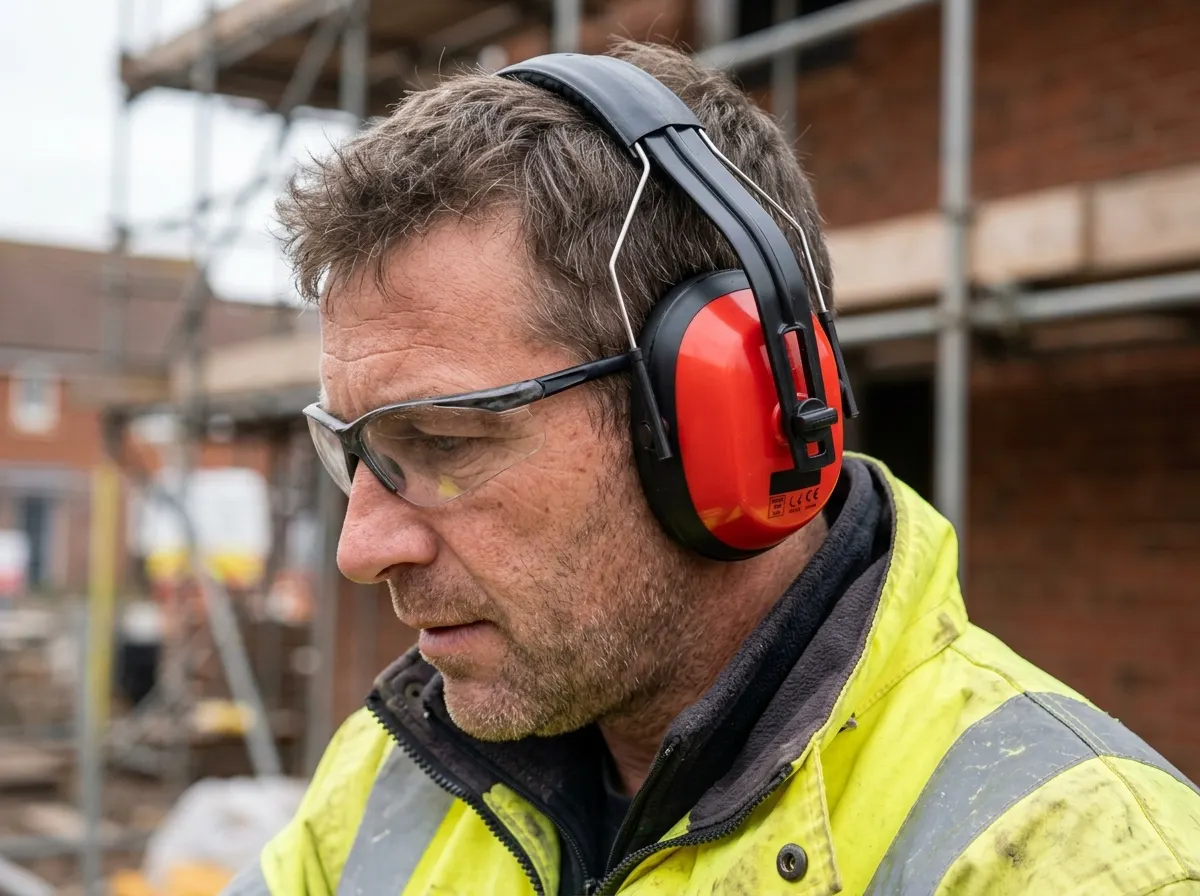
Hearing Protection
Prevents irreversible industrial deafness and tinnitus from high-decibel equipment.
When to use: When operating concrete breakers, angle grinders, circular saws, or working in confined spaces with loud echoes. Legally mandatory if noise exceeds 85 decibels.
How to use: Ensure ear defenders seal fully around the ear (watch out for thick safety glasses breaking the seal). Alternatively, roll foam earplugs tightly and insert deep into the ear canal, holding until they expand.
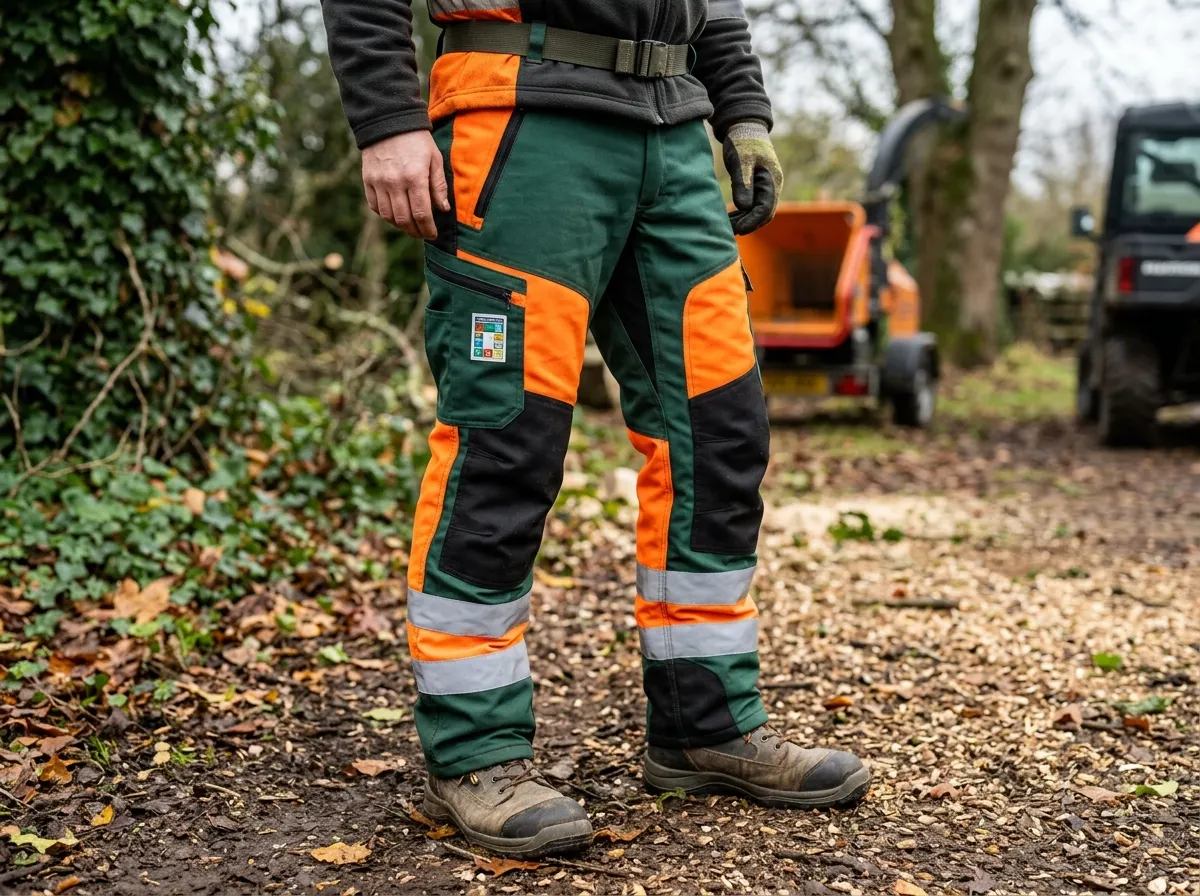
Chainsaw Safety Trousers
Contains specially woven ballistic fibers designed to instantly clog the chainsaw sprocket and stop the blade in milliseconds.
When to use: Strictly mandatory for landscapers, arborists, and general builders operating any type of chainsaw, no matter how quick the cut is.
How to use: Ensure they meet EN 381-5 standards. Never machine dry, iron, or bleach these trousers—high heat or harsh chemicals melt the internal protective fibers and destroy their stopping power.
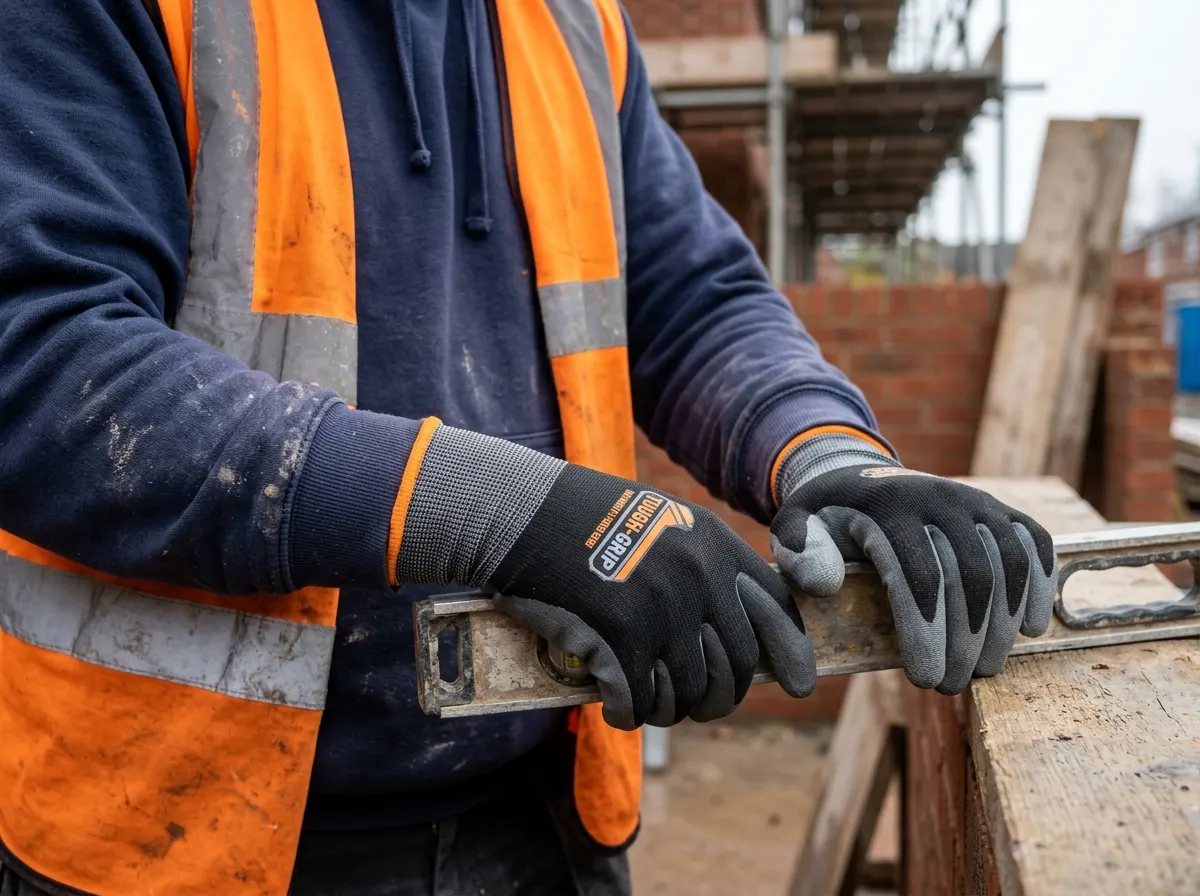
Protective Handwear (Gloves)
Prevents severe lacerations, chemical burns, contact dermatitis, and helps reduce Hand-Arm Vibration Syndrome (HAVS).
When to use: Handling raw masonry, sheet metal, or glass. Mixing cement/mortar (highly corrosive to skin), or using heavy vibrating breakers.
How to use: Match the glove to the specific hazard. Use EN 388 rated gloves for cut resistance, and nitrile gloves for chemical/cement protection. Avoid loose-fitting gloves around rotating machinery like core drills, as they can get caught.

Fall Arrest Harnesses
A full-body harness system designed to safely catch, decelerate, and suspend a worker if they fall from a height.
When to use: Operating MEWPs (cherry pickers), working on fragile roofs without edge protection, or working near exposed lift shafts and open edges.
How to use: Must be fitted snugly around the thighs and shoulders and attached to a tested anchor point using an energy-absorbing lanyard. By law, harnesses must be visually checked daily and formally inspected by a competent person every 6 months.

Eye & Face Protection
Guards against high-speed flying debris, chemical splashes, and intense light.
When to use: Operating grinders, drills, or nail guns. Mixing cement or handling corrosive cleaning agents.
How to use: Standard safety glasses are sufficient for light dust. However, for grinding metal or heavy stone cutting, full-face visors or wrap-around goggles must be used to stop debris entering from the sides.
Securing the Site: Equipment, Height & The Public
Your legal duty of care does not stop at your employees. Under Section 3 of the Health and Safety at Work Act, you are legally responsible for ensuring that your work does not put the general public at risk.
Protecting the Public & Site Boundaries
A construction site is a magnet for curious children, and delivery drivers or postmen will naturally walk straight through an active work zone if it is not physically blocked off. If a member of the public trips over an extension lead or falls into an open trench on your site, your business is fully liable.
- ✓ Heras Fencing: For structural work, extensions, or deep excavations, rigid steel mesh fencing clamped securely must enclose the entire site to prevent unauthorised access out of hours.
- ✓ Chapter 8 Barriers: When working on driveways, pavements, or public highways, high-visibility pedestrian barriers must be used to safely route the public away from machinery and trip hazards.
- ✓ Housekeeping: At the end of every day, tools must be locked away, power disconnected, and all materials stacked securely so they cannot blow over or collapse.

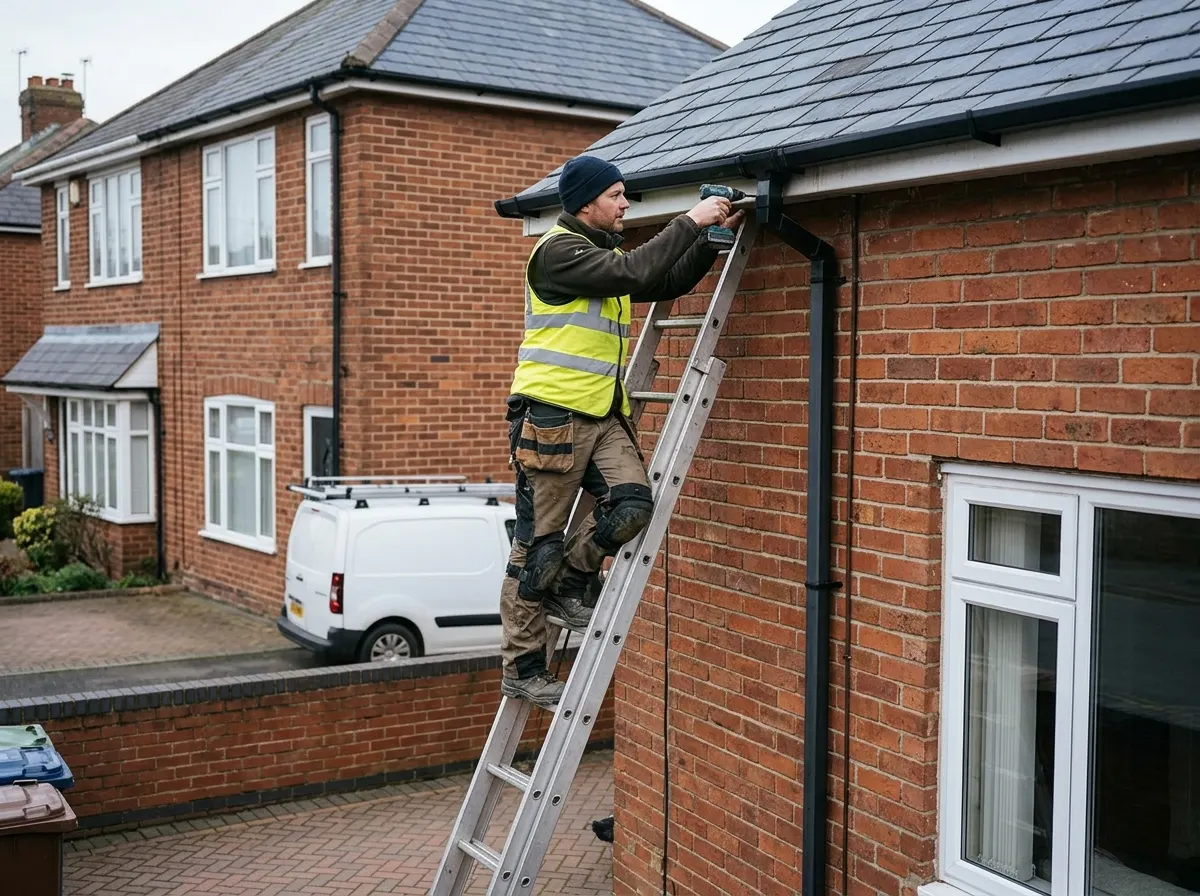
Working at Height & Ladder Laws
Falls from height remain the leading cause of fatal accidents in the UK workplace. The Work at Height Regulations 2005 state that work at height should be avoided where it is reasonably practicable to do so. When it cannot be avoided, ladders should be your last resort.
- ✓ The 30-Minute Rule: Ladders should only be used for low-risk, short-duration tasks (maximum 30 minutes at a single position). For anything longer, use a scaffold tower or MEWP (Mobile Elevating Work Platform).
- ✓ Three Points of Contact: When using a leaning ladder, the user must maintain three points of contact (e.g., two feet and one hand) at all times. Tools should be carried on a tool belt, not in your hands.
- ✓ Podium Steps: Instead of traditional stepladders, modern sites prefer podium steps, which provide a flat enclosed platform and safety rails to prevent falls.
Electrical Site Safety (110V)
On commercial sites and large domestic refits, standard 230V mains power tools are prohibited due to the risk of fatal electric shocks if a cable is severed. You must use 110V equipment powered through a yellow step-down isolation transformer. If 230V tools must be used temporarily, they must be strictly routed through an RCD (Residual Current Device) plug.
Equipment Inspections (PAT)
All electrical equipment brought onto site must be visually checked daily by the user for frayed cables or cracked casings. Furthermore, all power tools and heavy plant must undergo regular Portable Appliance Testing (PAT). Most main contractors will eject a subcontractor from the site if their tools do not display an in-date PAT testing sticker.
Stop paying for dead leads.
Join the Pricing Penguin network. We provide UK tradespeople with high-intent, pre-qualified customers who already understand the true cost of quality craftsmanship.
Integrating Safety into the Employee Handbook
Your staff handbook is your primary line of defense. If a safety rule is not explicitly documented, it is very difficult to legally discipline an employee for breaking it.
Health and safety policies must be tailored to the specific environment. For example, if you run a mechanics garage or MOT testing centre, your handbook must heavily feature workshop operations—detailing exactly how vehicle lifts are operated, where hazardous fluids are stored, and the strict coordination rules within the MOT bay to prevent public access.
Similarly, for site trades, the handbook should explicitly state that using a mobile phone while operating machinery or driving a company vehicle is a gross misconduct offense leading to instant dismissal.
Handbook Essentials:
- ✓ Drug and alcohol testing policies
- ✓ Accident reporting procedures (RIDDOR)
- ✓ Vehicle and tool safety checks
- ✓ Workshop / Site rules
Statutory Signage Requirements
The Health and Safety (Safety Signs and Signals) Regulations 1996 dictate that signs must be used where a significant risk cannot be avoided or controlled by other means. Colour coding is legally defined.
Prohibition (Red)
Must not do. Stops dangerous behaviour.
Example: "No Unauthorised Entry"
Warning (Yellow)
Hazard or danger ahead.
Example: "Danger: High Voltage"
Mandatory (Blue)
A specific action must be taken.
Example: "Safety Helmets Must Be Worn"
Safe Condition (Green)
The safe way out or safety equipment.
Example: "Fire Exit / First Aid"
Frequently Asked Questions
What is RIDDOR and when do I report?
RIDDOR stands for the Reporting of Injuries, Diseases and Dangerous Occurrences Regulations. You are legally required to report specific incidents to the HSE. This includes deaths, major injuries (like fractures or amputations), dangerous occurrences (like a scaffolding collapse), or if a worker is incapacitated for more than 7 consecutive days due to a workplace injury.
Do I need a First Aid kit in the van?
Yes. Under the Health and Safety (First-Aid) Regulations 1981, employers must provide adequate and appropriate equipment. For mobile trade workers traveling away from a fixed base, a stocked and up-to-date travel first aid kit in every company vehicle is mandatory.
Can an HSE inspector enter my site without permission?
Yes. HSE inspectors have sweeping legal powers. They can enter any workplace at any reasonable time without a warrant, investigate, take photographs, dismantle equipment, seize documents, and interview employees. Obstructing an inspector is a criminal offence.
What happens if the HSE inspects my site and finds a fault?
If an HSE inspector visits your site and identifies a "material breach" of health and safety law (e.g., missing edge protection or lack of RAMS), they will apply their Fee for Intervention (FFI) scheme [1]. As of April 2026, you will be charged £188 per hour for the entire time the inspector spends identifying the issue, writing to you, and helping you put it right [1, 2]. These fees can quickly run into thousands of pounds, completely wiping out your profit margin on the job.
Am I legally required to provide a toilet on a domestic job?
Yes. Under the CDM Regulations 2015, adequate welfare facilities must be available from day one of the project [3, 4]. You cannot legally rely on sending your team to a local cafe or public toilet. There must be access to a flushing toilet, hot/warm running water, soap, and a clean place to rest and eat [4]. If the homeowner does not allow you to use their domestic facilities, you must hire a portable site toilet and factor this into your quote.
Do I need a written health and safety policy as a sole trader?
Legally, the Health and Safety at Work Act 1974 only requires you to have a written health and safety policy (including written risk assessments) if you employ five or more people. However, in practice, if you want to work as a subcontractor for any large building firm or local authority, they will almost always demand to see your written RAMS (Risk Assessments and Method Statements) before allowing you on site, regardless of how small your business is.
Do I need an asbestos survey before starting a domestic renovation?
Yes, if the property was built before the year 2000. Before any structural work or demolition begins that will disturb the fabric of the building, you must ensure a "Refurbishment and Demolition (R&D) Asbestos Survey" has been carried out. A standard homeowner's 'Management Survey' is not sufficient. If you start knocking down walls without one and expose your team to asbestos fibers, you can face severe criminal prosecution under the Control of Asbestos Regulations 2012.
What is a CSCS card?
The Construction Skills Certification Scheme (CSCS) provides physical cards proving that a worker has the required training and qualifications for their job. While not a legal requirement itself, almost all major UK contractors insist workers hold a valid CSCS card to prove baseline health and safety awareness before allowing them on site.
Ready to fill your diary with quality jobs?
Connect with serious homeowners who value reliability over the absolute cheapest quote. Join our network of accredited UK tradespeople today and let our AI estimators filter out the time-wasters for you.
Related Guides




Did you find this guide helpful?
Let us know if these marketing tips will help your trade business.